
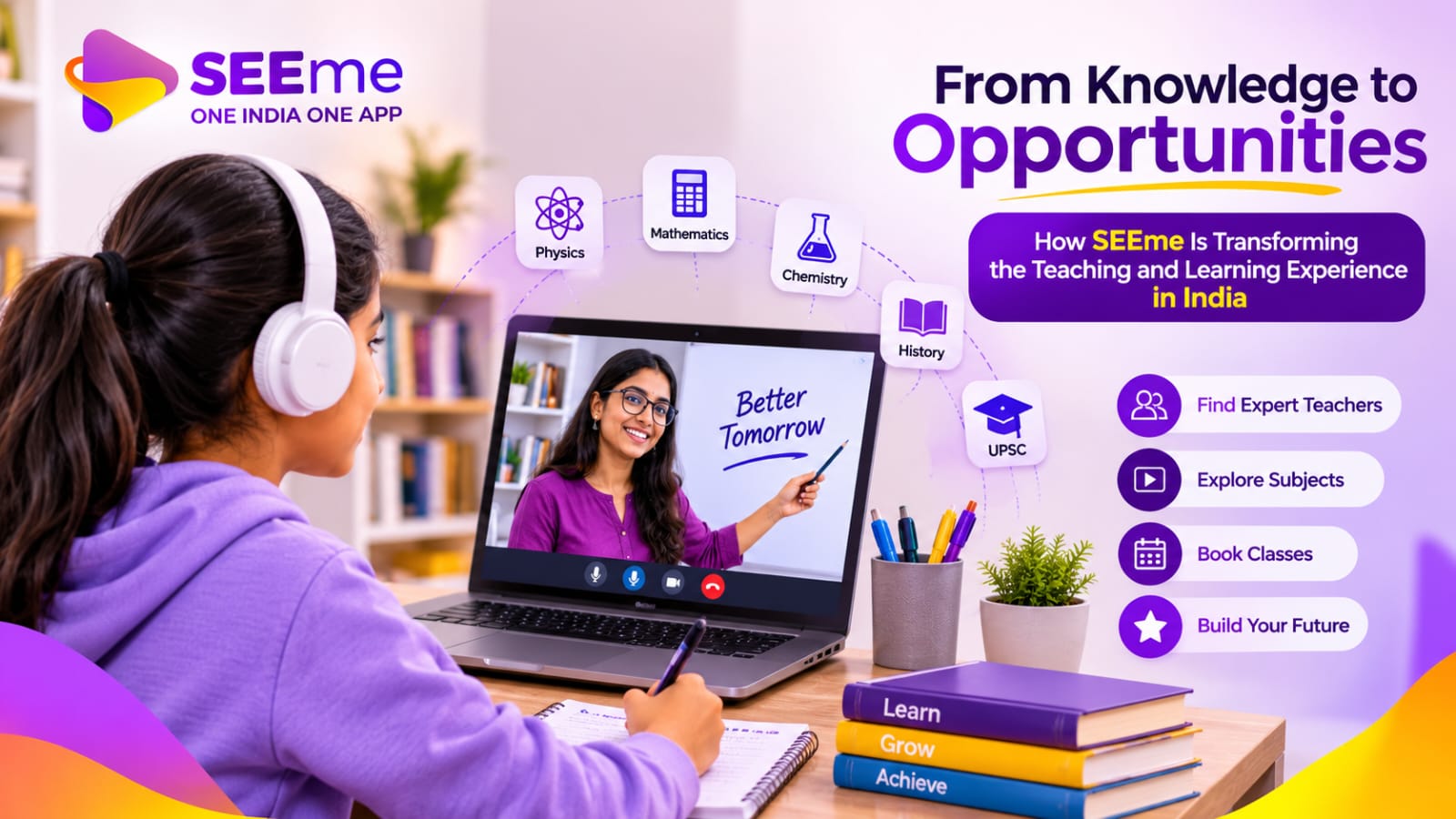
From Knowledge to Opportunities: How SEEme Is Transforming the Teaching and Learning Experience in India
Published: November 3, 2026
Category: Teacher
Author: SEEme Team
Education has always been one of the strongest foundations of personal and professional growth. But today, learning is no longer limited to classrooms, schools or traditional coaching centres.
A student preparing for board examinations, a graduate pursuing higher education, an aspirant preparing for UPSC, or a professional looking to develop new skills may all need something different: the right teacher, the right subject expertise and a learning experience that matches their goals.
SEEme brings teachers and learners together through an integrated professional marketplace and social platform where educators can showcase their expertise, students can discover specialised teaching professionals, and knowledge can create new professional opportunities.
Whether you are an experienced educator, a subject specialist, an academic mentor or someone beginning your teaching journey, SEEme offers another way to establish your professional identity, showcase your knowledge and connect with people looking for your expertise.
Education Is Everywhere. Finding the Right Teacher Is the Challenge.
Learning opportunities have expanded significantly.
A school student may need help with Mathematics or Physics. A commerce student may be searching for guidance in Accounting or Business Studies. An engineering student may need support with technical subjects. A UPSC aspirant may be looking for structured preparation, while a postgraduate student may need specialised academic guidance.
Similarly, someone interested in filmmaking, literature, languages, animation-related technology or professional courses may be searching for an experienced educator who understands their learning requirements.
But finding the right teacher is not always easy.
Students often depend on recommendations, local coaching centres, social media groups and multiple online platforms. Teachers, meanwhile, may struggle to reach learners beyond their existing networks.
A highly knowledgeable teacher may have years of experience but limited digital visibility.
A subject specialist may be excellent at explaining complex concepts but lack a dedicated platform to showcase their expertise.
That is where a professional education discovery platform can make a meaningful difference.
SEEme provides teachers with a dedicated professional environment to present their specialisations, knowledge, experience and teaching services.
For teachers, it creates another opportunity to reach learners.
For students, it makes discovering specialised educators more organised and accessible.
What Does a Teacher Actually Need?
Teaching is much more than explaining a subject.
An educator often performs several important roles:
- Subject expert
- Mentor and guide
- Communicator
- Learning facilitator
- Academic professional
- Personal brand builder
- Independent service provider
Consider a Physics teacher who can explain difficult concepts but struggles to find students outside their local area.
A Mathematics educator may have excellent teaching methods but need a better way to showcase their expertise.
A commerce professional may be qualified to teach advanced subjects but find it difficult to reach students pursuing specialised courses.
The challenge is not necessarily a lack of knowledge or teaching ability.
It is often the gap between expertise, visibility and professional opportunities.
SEEme is designed to help bridge this gap by bringing professional discovery, social engagement and service opportunities together in one platform.
One Platform, Multiple Areas of Teaching Expertise
SEEme's Teacher category brings together 26 specialised teaching areas, covering school-level subjects, undergraduate and postgraduate education, competitive examinations, professional courses, technical education and specialised learning.
The Teacher category includes:
1. Special Needs Education
2. Professional Commerce Course
3. Physics (Board Exam)
4. Engineering
5. MSc Course
6. BCom Course
7. MCom Course
8. VFX Course
9. UPSC Course
10. Medical Studies
11. Management Studies
12. Mathematics (Board Exam)
13. Mass Communication & Journalism
14. MA Course
15. Literature Course
16. Life Science (Board Exam)
17. Language Course
18. History (Board Exam)
19. Geography (Board Exam)
20. Filmmaking & Film Studies
21. Economics (Board Exam)
22. Chemistry (Board Exam)
23. CAD Course
24. BSc Course
25. Biology (Board Exam)
26. BA Course
This variety reflects how modern education extends beyond conventional school tuition.
Let's explore how different teaching professionals can benefit from better discovery and professional connections.
1. Special Needs Education
Every learner has different educational requirements, learning preferences and developmental needs.
Special Needs Education focuses on supporting learners who may benefit from individualised teaching approaches, adapted learning materials and specialised educational guidance.
Educators in this field may work with learners who need support with:
- Individualised learning plans
- Inclusive education
- Learning difficulties
- Special education techniques
- Developmental learning support
- Adaptive teaching methods
SEEme provides special education professionals with another opportunity to showcase their expertise and connect with families and learners looking for specialised educational guidance.
For parents, it creates an additional way to discover educators whose experience aligns with their child's learning requirements.
2. Professional Commerce Course
Commerce education opens doors to careers in accounting, finance, taxation, business and corporate management.
Students pursuing professional commerce qualifications often need specialised guidance to understand complex concepts and prepare for examinations.
Relevant subject areas may include:
- Financial Accounting
- Cost Accounting
- Management Accounting
- Auditing
- Taxation
- Business Law
- Financial Management
- Corporate Accounting
Commerce educators can use SEEme to present their professional knowledge, teaching experience and specialised services to students looking for academic and professional commerce guidance.
3. Physics (Board Exam)
Physics helps students understand the fundamental principles governing the natural world.
For board examination students, the subject requires conceptual understanding, mathematical application and regular problem-solving practice.
Important subject areas include:
- Mechanics
- Laws of Motion
- Work, Energy and Power
- Gravitation
- Thermodynamics
- Waves and Oscillations
- Electrostatics
- Current Electricity
- Magnetism
- Optics
- Modern Physics
Physics teachers can showcase their teaching approach, subject expertise and examination preparation services.
Students can discover educators who help make difficult concepts easier to understand.
4. Engineering
Engineering education combines scientific knowledge, mathematics and practical problem-solving.
Students pursuing engineering degrees often need guidance across specialised technical disciplines.
Relevant engineering areas may include:
- Computer Science Engineering
- Mechanical Engineering
- Civil Engineering
- Electrical Engineering
- Electronics and Communication
- Chemical Engineering
- Engineering Mathematics
- Programming and Technical Fundamentals
- Engineering Mechanics
SEEme gives engineering educators an opportunity to present their technical expertise and connect with students seeking subject-specific academic guidance.
5. MSc Course
Postgraduate science education requires deeper subject understanding, research-oriented thinking and specialised academic knowledge.
MSc students may need guidance across different scientific disciplines.
These may include:
- Mathematics
- Physics
- Chemistry
- Biology
- Biotechnology
- Microbiology
- Environmental Science
- Computer Science
- Statistics
- Zoology
- Botany
SEEme allows postgraduate subject specialists to showcase their knowledge and connect with learners pursuing advanced scientific education.
6. BCom Course
Bachelor of Commerce is an important academic pathway for students interested in business, finance and accounting.
BCom students study a range of subjects that build their understanding of commercial and financial systems.
These may include:
- Financial Accounting
- Business Economics
- Business Mathematics
- Business Law
- Corporate Accounting
- Cost Accounting
- Income Tax
- Auditing
- Banking and Insurance
- Business Management
Commerce educators can present their subject specialisations and connect with students looking for undergraduate academic support.
7. MCom Course
Master of Commerce provides advanced academic knowledge in accounting, finance, economics and business administration.
Students pursuing MCom may require specialised support in areas such as:
- Advanced Accounting
- Corporate Financial Reporting
- Financial Management
- Business Research
- Taxation
- Banking
- Auditing
- International Business
- Business Economics
- Corporate Governance
SEEme offers MCom educators another opportunity to make their postgraduate teaching expertise discoverable to students.
8. VFX Course
Visual Effects (VFX) combines technology and creativity to produce digital visual experiences.
From films and advertisements to gaming and digital entertainment, VFX professionals contribute to modern visual storytelling.
Teaching areas may include:
- Compositing
- Motion Graphics
- 3D Modelling
- Texturing
- Lighting
- Rendering
- Rotoscoping
- Match Moving
- Visual Effects Software
- Digital Production Techniques
VFX educators can showcase their technical knowledge and creative experience while connecting with aspiring digital artists and visual effects professionals.
9. UPSC Course
Civil services preparation requires discipline, conceptual understanding, analytical thinking and consistent examination practice.
UPSC aspirants often study a wide range of subjects and need guidance from educators with relevant academic and examination expertise.
Important preparation areas include:
- Indian History
- Indian Polity and Constitution
- Indian Geography
- Indian Economy
- Environment and Ecology
- General Science
- Current Affairs
- Ethics and Integrity
- Governance
- International Relations
- CSAT
- Answer Writing and Essay Preparation
SEEme provides UPSC educators with another platform to present their subject expertise and connect with aspirants looking for structured preparation support.
10. Medical Studies
Medical education requires detailed scientific understanding, conceptual clarity and continuous academic preparation.
Students pursuing medical studies may need guidance across subjects such as:
- Anatomy
- Physiology
- Biochemistry
- Pathology
- Pharmacology
- Microbiology
- Forensic Medicine
- Community Medicine
- Medicine
- Surgery
- Biology
- Human Physiology
Medical educators can showcase their academic specialisations and connect with students seeking subject-focused educational guidance.
11. Management Studies
Management education prepares students to understand organisations, leadership, business operations and decision-making.
It is relevant to students pursuing undergraduate, postgraduate and professional management programmes.
Teaching areas may include:
- Principles of Management
- Human Resource Management
- Marketing Management
- Financial Management
- Operations Management
- Business Communication
- Strategic Management
- Organisational Behaviour
- Entrepreneurship
- Business Analytics
- International Business
SEEme helps management educators showcase their expertise and connect with students looking to strengthen their business and management knowledge.
12. Mathematics (Board Exam)
Mathematics is one of the most important subjects in school education.
It develops logical reasoning, analytical thinking and problem-solving abilities.
Students may need guidance in:
- Algebra
- Geometry
- Trigonometry
- Calculus
- Coordinate Geometry
- Statistics
- Probability
- Mensuration
- Arithmetic
- Mathematical Reasoning
SEEme provides Mathematics teachers with another opportunity to showcase their teaching methods, academic experience and examination preparation expertise.
For students, it offers a way to discover educators who can help simplify mathematical concepts.
13. Mass Communication & Journalism
Mass Communication and Journalism focus on how information, stories and ideas reach audiences through different media.
Students pursuing these fields need both theoretical understanding and practical communication skills.
Subject areas may include:
- Journalism
- News Reporting
- Editing
- Public Relations
- Advertising
- Digital Media
- Media Ethics
- Communication Theory
- Broadcast Journalism
- Media Production
- Film and Television Studies
SEEme allows educators in media and communication to showcase their knowledge and connect with students interested in media careers.
14. MA Course
Master of Arts programmes cover a wide range of humanities and social science disciplines.
Students pursuing postgraduate education may require guidance in advanced theories, research methods and specialised subjects.
Relevant disciplines may include:
- English
- History
- Political Science
- Sociology
- Psychology
- Economics
- Geography
- Philosophy
- Education
- Public Administration
- International Relations
SEEme gives postgraduate educators an opportunity to present their academic specialisations and connect with learners pursuing higher education.
15. Literature Course
Literature helps students explore language, culture, society, imagination and human experiences through written works.
It develops critical thinking, interpretation and communication skills.
Teaching areas may include:
- English Literature
- Indian Literature
- World Literature
- Poetry
- Drama
- Fiction
- Literary Criticism
- Literary Theory
- Comparative Literature
- Modern Literature
- Classical Literature
Literature educators can showcase their subject knowledge and connect with students who want to develop a deeper understanding of literary works.
16. Life Science (Board Exam)
Life Science helps students understand living organisms, biological processes and the relationship between organisms and their environment.
Relevant areas may include:
- Cell Biology
- Genetics
- Evolution
- Ecology
- Plant Physiology
- Human Physiology
- Reproduction
- Biotechnology
- Biodiversity
- Microbiology
SEEme offers Life Science teachers another opportunity to showcase their expertise and connect with students preparing for board examinations.
17. Language Course
Language education plays an important role in communication, academic development and professional growth.
Students may want to learn a new language, improve their existing language skills or develop better communication abilities.
Teaching areas may include:
- English
- Hindi
- Sanskrit
- Bengali
- French
- German
- Spanish
- Japanese
- Spoken English
- Grammar and Vocabulary
- Reading and Writing
- Communication Skills
SEEme allows language educators to present their teaching expertise and connect with learners interested in language development.
18. History (Board Exam)
History helps students understand past events, civilisations, societies and the development of the modern world.
It develops analytical thinking and the ability to understand historical developments in context.
Important subject areas may include:
- Ancient Indian History
- Medieval Indian History
- Modern Indian History
- World History
- Indian National Movement
- European History
- Political History
- Cultural History
- Social History
SEEme gives History teachers another opportunity to showcase their academic knowledge and connect with students preparing for board examinations.
19. Geography (Board Exam)
Geography helps students understand the physical environment, human settlements, natural resources and geographical relationships.
Subject areas may include:
- Physical Geography
- Human Geography
- Indian Geography
- World Geography
- Climatology
- Geomorphology
- Oceanography
- Population Geography
- Economic Geography
- Environmental Geography
- Map Reading and Cartography
Geography teachers can present their specialisations and connect with students seeking help with geographical concepts and examination preparation.
20. Filmmaking & Film Studies
Film education combines creativity, technology, visual communication and storytelling.
Students interested in filmmaking and cinema may need guidance in both practical production and theoretical film studies.
Relevant areas may include:
- Film Direction
- Cinematography
- Screenwriting
- Film Editing
- Sound Design
- Production Design
- Film History
- Film Appreciation
- Documentary Filmmaking
- Visual Storytelling
- Film Production
SEEme provides filmmaking educators and film studies professionals with another space to showcase their knowledge and connect with aspiring filmmakers.
21. Economics (Board Exam)
Economics helps students understand how individuals, businesses and governments make decisions involving resources, production and consumption.
Important subject areas include:
- Microeconomics
- Macroeconomics
- Demand and Supply
- National Income
- Money and Banking
- Government Budget
- International Trade
- Development Economics
- Indian Economic Development
- Statistics for Economics
SEEme allows Economics teachers to showcase their subject expertise and connect with students who need academic support and examination preparation.
22. Chemistry (Board Exam)
Chemistry explores the composition, properties and transformations of matter.
Students studying Chemistry need conceptual understanding, numerical practice and knowledge of chemical reactions.
Relevant subject areas include:
- Physical Chemistry
- Organic Chemistry
- Inorganic Chemistry
- Atomic Structure
- Chemical Bonding
- Chemical Equilibrium
- Thermodynamics
- Electrochemistry
- Chemical Kinetics
- Coordination Compounds
- Biomolecules
SEEme provides Chemistry educators with another opportunity to present their expertise and connect with students looking for subject-specific guidance.
23. CAD Course
Computer-Aided Design (CAD) is widely used in engineering, architecture, product development and industrial design.
CAD education helps students and professionals develop technical drawing and digital design skills.
Teaching areas may include:
- 2D Drafting
- 3D Modelling
- Technical Drawing
- AutoCAD
- SolidWorks
- CATIA
- Revit
- Engineering Design
- Mechanical Drafting
- Architectural Design
- Product Design
CAD instructors can showcase their practical knowledge and connect with learners interested in developing technical design skills.
24. BSc Course
Bachelor of Science programmes offer undergraduate education across various scientific disciplines.
Students may require academic guidance in theoretical concepts, numerical problems, practical applications and subject-specific coursework.
Relevant subject areas may include:
- Physics
- Chemistry
- Mathematics
- Biology
- Computer Science
- Statistics
- Botany
- Zoology
- Biotechnology
- Microbiology
- Environmental Science
SEEme allows BSc educators to showcase their subject specialisations and connect with undergraduate students seeking academic assistance.
25. Biology (Board Exam)
Biology helps students understand living organisms, their structures, functions and interactions with the environment.
It is an important subject for students interested in medicine, biotechnology and life sciences.
Relevant subject areas include:
- Cell Biology
- Genetics
- Human Physiology
- Plant Physiology
- Reproduction
- Evolution
- Ecology
- Biotechnology
- Molecular Biology
- Biodiversity
- Human Health and Disease
SEEme gives Biology teachers another opportunity to showcase their teaching expertise and connect with students preparing for board examinations.
26. BA Course
Bachelor of Arts programmes offer students the opportunity to explore humanities, languages and social sciences.
BA students often need support in understanding academic theories, developing analytical abilities and preparing for examinations.
Relevant disciplines may include:
- English
- Hindi
- History
- Political Science
- Sociology
- Psychology
- Economics
- Geography
- Philosophy
- Education
- Public Administration
- Anthropology
SEEme provides BA educators with a professional space to present their academic expertise and connect with undergraduate students.
How SEEme Helps Teachers Turn Knowledge into Opportunities
Having knowledge is the beginning of a teaching career. Reaching the right learners and creating professional opportunities is the next step.
SEEme brings together several important stages of a teacher's professional journey.
1. Create Your Professional Profile
Build your professional identity by sharing your educational background, experience, qualifications, teaching specialisation and expertise.
2. Showcase Your Teaching Expertise
Present your knowledge, teaching content and academic specialisations so students can understand what you teach and how your expertise can help them.
3. Create Customised Packages and Availability Slots
Define your teaching services, create customised packages, set your pricing and make your professional availability accessible to interested learners.
4. Get Discovered by Students
Become part of a professional environment where learners can explore teaching categories, subject specialisations and educators based on their requirements.
5. Connect and Get Booked
Students can explore teacher profiles, understand their offerings, connect with educators and proceed with bookings through the platform.
6. Monetise Your Knowledge
Turn your academic knowledge, teaching experience and subject expertise into potential earning opportunities through the services you offer.
The journey is simple: showcase your knowledge, make your expertise discoverable and create opportunities to grow.
The Student's Side: Finding the Right Teacher Without Guesswork
Imagine a student preparing for board examinations who needs help with Physics.
They may search through social media, ask friends for recommendations, explore different tuition options and contact multiple teachers to understand their teaching methods, availability and pricing.
The process can become time-consuming.
Now imagine a commerce student looking for an MCom educator or an engineering student searching for guidance in a specialised technical subject.
The challenge is not always the availability of teachers.
It is fragmented discovery.
SEEme aims to make this process more structured by bringing specialised educators and learners together.
Students can explore teacher profiles, understand their subject expertise, discover available packages and connect with professionals based on their learning requirements.
This changes the search from:
"Who can I ask for a teacher recommendation?"
To:
"Which teacher has the expertise I am looking for?"
Whether someone needs Mathematics tuition, UPSC preparation, commerce education, language learning or postgraduate academic guidance, SEEme aims to simplify professional discovery.
The Teacher's Side: Your Knowledge Is Your Professional Identity
For teachers, professional growth should not depend entirely on word-of-mouth recommendations or local visibility.
An experienced educator may have excellent subject knowledge but a limited student network.
A postgraduate specialist may be capable of teaching advanced concepts but may struggle to reach learners who need that expertise.
A language instructor may have effective teaching methods but need a better way to present their professional services.
This is why building a professional teaching profile matters.
Your profile can communicate:
- What subjects you teach.
- Your academic qualifications.
- Your teaching experience.
- Your areas of specialisation.
- The services you offer.
- Your teaching packages and availability.
A professional identity helps potential students understand your capabilities before choosing to connect with you.
Your value as an educator should reflect your knowledge, teaching abilities and experience, not simply your existing network.
The Unexpected Advantage: Better Teacher-Student Matches
The most popular teacher is not necessarily the right teacher for every student.
A student struggling with basic Mathematics may need an educator who specialises in building foundational concepts.
A UPSC aspirant may need a teacher with strong knowledge of Indian Polity and History.
An engineering student may need guidance from a specialist in Mechanical Engineering rather than a general academic tutor.
Similarly, someone learning a new language may prefer a teacher who focuses on practical communication rather than only grammar.
This is why specialised professional discovery matters.
SEEme brings different teaching specialisations into one environment, helping learners explore educators based on the knowledge and expertise they require.
For teachers, this creates another opportunity to connect with learners who value their particular subject specialisation.
SEEme Is More Than an Education Marketplace
Traditional education platforms often focus mainly on classes, courses or transactions.
But teaching is about more than delivering lessons.
It is about knowledge, communication, guidance, trust and the relationship between educators and learners.
A teacher brings experience, expertise and a unique approach to education. A student looks for someone who can understand their learning requirements and help them develop their knowledge.
That is why SEEme goes beyond simply connecting teachers and students.
With its integrated social media experience, SEEme brings professional discovery and social engagement together.
Teachers get an opportunity to showcase their expertise, share professional content and build their digital identity.
Students can explore educators, discover their specialisations and engage with professional content in a more interactive environment.
The platform brings together learning discovery, professional services and meaningful connections.
The Future of Education Is Personalised and Discoverable
The future of education will not simply ask:
"Which subject do you want to study?"
It will also ask:
"Which area do you need help with?"
"What kind of teacher would suit your learning requirements?"
"Which specialist can help you understand the subject better?"
"And how can learners connect with the right educator?"
That is where specialised teacher discovery becomes powerful.
Whether you are a Physics teacher helping board examination students, a commerce educator teaching professional subjects, a UPSC mentor guiding aspirants, an engineering specialist sharing technical knowledge or a language instructor helping learners develop communication skills, SEEme creates another path between your knowledge and the people looking for it.
And for students, the same platform can turn an overwhelming search into a much simpler question:
"Who is the right teacher for me?"
SEEme aims to make these connections easier by bringing Indian professionals, teachers and learners together on one vibrant platform where knowledge, expertise and opportunities can meet.
Your Knowledge Deserves More Than Just a Classroom!
Your experience has value. Your expertise deserves recognition. Your knowledge deserves opportunities.
Showcase your teaching skills, build your professional identity, create customised teaching packages, manage your availability, connect with potential students and get booked on SEEme.
Whether you are a school teacher, postgraduate educator, subject specialist, professional course instructor or an aspiring academic mentor, take the next step towards building your professional teaching journey.
Your Knowledge. Your Identity. Your Opportunities.
Join SEEme Today!
Website: https://www.seeme.co.in
SEEme – One India. One App.


